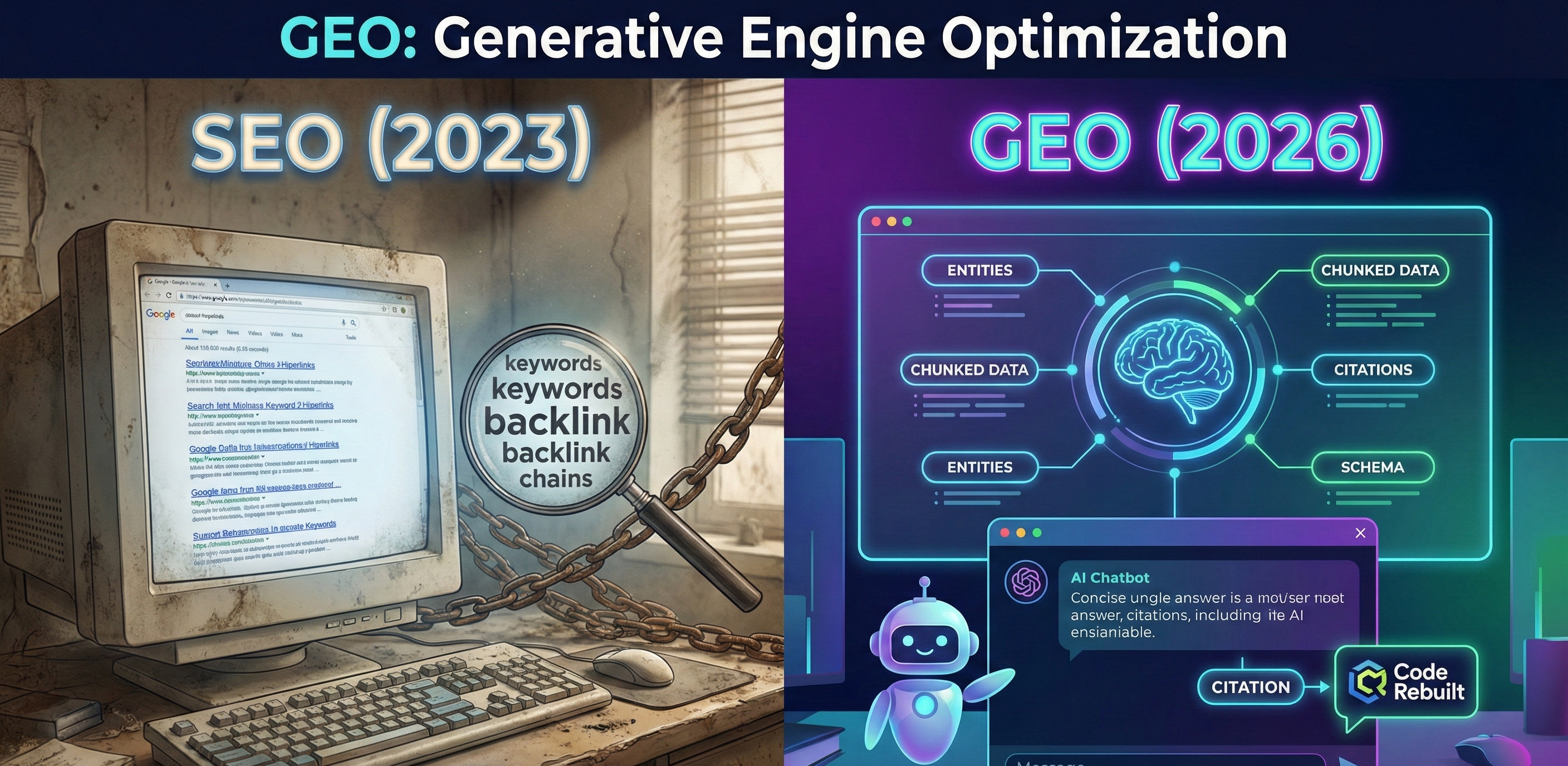
For 20 years, the goal of marketing was simple: Rank #1 on Google. You picked keywords, wrote 2,000-word articles, and built backlinks.
But in 2026, the game has changed. Millions of users aren't "Googling" their questions anymore—they are asking ChatGPT, Perplexity, or Gemini.
These AI engines don't give you a list of ten blue links to choose from. They give you one single, synthesized answer.
If your startup isn't the source of that answer, you don't exist.
Welcome to the new discipline of Generative Engine Optimization (GEO). Unlike traditional SEO, which fights for clicks, GEO fights for citations. Here is how Code Rebuilt helps you win in this new landscape.
GEO vs. SEO: The Core Differences
To win at GEO, you must unlearn some traditional SEO habits.
-
SEO optimizes for a retrieval engine (finding the best document).
-
GEO optimizes for a generation engine (synthesizing the best answer).
Here is the breakdown:
| Feature | Traditional SEO | Generative Engine Optimization (GEO) |
| Primary Goal | Get a user to click a link. | Get an AI to cite your content. |
| Target Audience | Humans searching keywords. | Large Language Models (LLMs) building answers. |
| Success Metric | Traffic & Rankings (#1 position). | Share of Voice & Citation Frequency. |
| Content Style | Long-form, comprehensive guides. | Concise, factual, "chunked" data. |
| Authority Signal | Backlinks (PageRank). | Entity Salience & Brand Mentions. |
The 3 Pillars of GEO Strategy
Optimizing for AI requires a different technical approach. LLMs value structure, data, and authority above flowery prose.
1. "Content Chunking" & The Inverted Pyramid
AI models struggle to extract facts buried in paragraph 4 of a long intro. To rank in GEO, you must structure your content in "chunks" that are easy for a bot to grab and quote.
The Strategy: Write like a journalist.
-
The Answer: Start with the direct definition or answer in the first sentence.
-
The Data: Follow immediately with supporting statistics or evidence.
-
The Context: Save the nuance and backstory for later.
Bad for GEO: "When considering web frameworks, many developers have found that Next.js offers superior performance..." (Too vague).
Good for GEO: "Next.js improves website index speed by 40%. It is the preferred framework for SEO because of its native Server-Side Rendering (SSR) capabilities." (Highly citable).
2. Entity Optimization (The "Knowledge Graph")
Google and ChatGPT don't think in "keywords" anymore; they think in Entities (Concepts, People, Brands).
If an AI doesn't understand who you are, it won't cite you.
The Fix:
-
Define Your Brand: Ensure your "About Us" page clearly states what you do and who you serve using standard nouns.
-
Schema Markup: Use JSON-LD Schema to explicitly tell the AI, "This is a Service," "This is a Review," or "This is the Author."
-
Consistent Naming: Never use vague terms like "our solution." Always use your brand name (e.g., "Code Rebuilt's dashboard") to reinforce the entity connection.
3. Be the Source of "Hard Data"
LLMs are designed to minimize "hallucinations." They crave unique statistics to ground their answers.
If you publish a generic "Guide to Web Design," you are noise. But if you publish "Benchmarks of 50 Next.js Sites in 2026," you become a primary source.
-
Tactic: Run small internal surveys or benchmarks and publish the raw numbers. AI engines love citing percentages.
How to Optimize for Specific Engines
Not all AIs work the same way. Here is the nuance:
Optimizing for Perplexity & Google AI Overviews
These engines have live access to the web. They are "Answer Engines."
-
Focus: Freshness and Citation Authority.
-
Tactic: Update your content dates frequently. Use
LastUpdatedschema. Ensure your content is referenced on other authoritative sites (even unlinked mentions count!).
Optimizing for ChatGPT & Claude
These models rely heavily on their training data, though they can browse.
-
Focus: Authority and Brand Salience.
-
Tactic: You need to be "in the conversation" across the web. Being discussed on Reddit, Hacker News, and industry forums helps "train" the model that your brand is relevant to specific topics.
The Technical Edge: Why Code Rebuilt Wins
At Code Rebuilt, we don't just write content; we architect it for machines.
We use Next.js to deliver ultra-fast, server-rendered HTML that AI bots can parse instantly. We implement deep Knowledge Graph Schema that connects your authors, your brand, and your content into a web of trust that LLMs can't ignore.
The battle for AI visibility is won in the code as much as the copy.
Is your startup invisible to ChatGPT?
Start Your Project with Code Rebuilt and let's build a digital presence that dominates the AI future.