"Human Clickbait": Why Personal Experience is the New SEO Gold Standard in 2026
The internet in 2026 is noisy. We are drowning in a sea of perfectly grammatically correct, yet utterly soulless content generated by AI.
For startups attempting to build an online presence, the old playbook—target a keyword, write a 1,500-word generic guide, hire some backlinks—is dead. If an AI can generate the same answer in three seconds, Google has zero incentive to rank your webpage.
At Code Rebuilt, we build high-performance technical foundations using Next.js and React. But a fast website needs a compelling reason for users to visit.
Enter the new era of SEO: the age of "Human Clickbait." It’s not about tricking users; it’s about providing the one thing AI cannot replicate: authentic, messy, real-world experience.
What is "Human Clickbait"?
It sounds pejorative, but in 2026, "Human Clickbait" is a positive term. It refers to content that is compelling and clickable specifically because it is clearly written by a human being who has actually lived through the topic.
AI can scrape the entire internet to define "what" something is. But it cannot tell you "how it felt" when it went wrong, or the nuanced decision-making process you used to fix it.
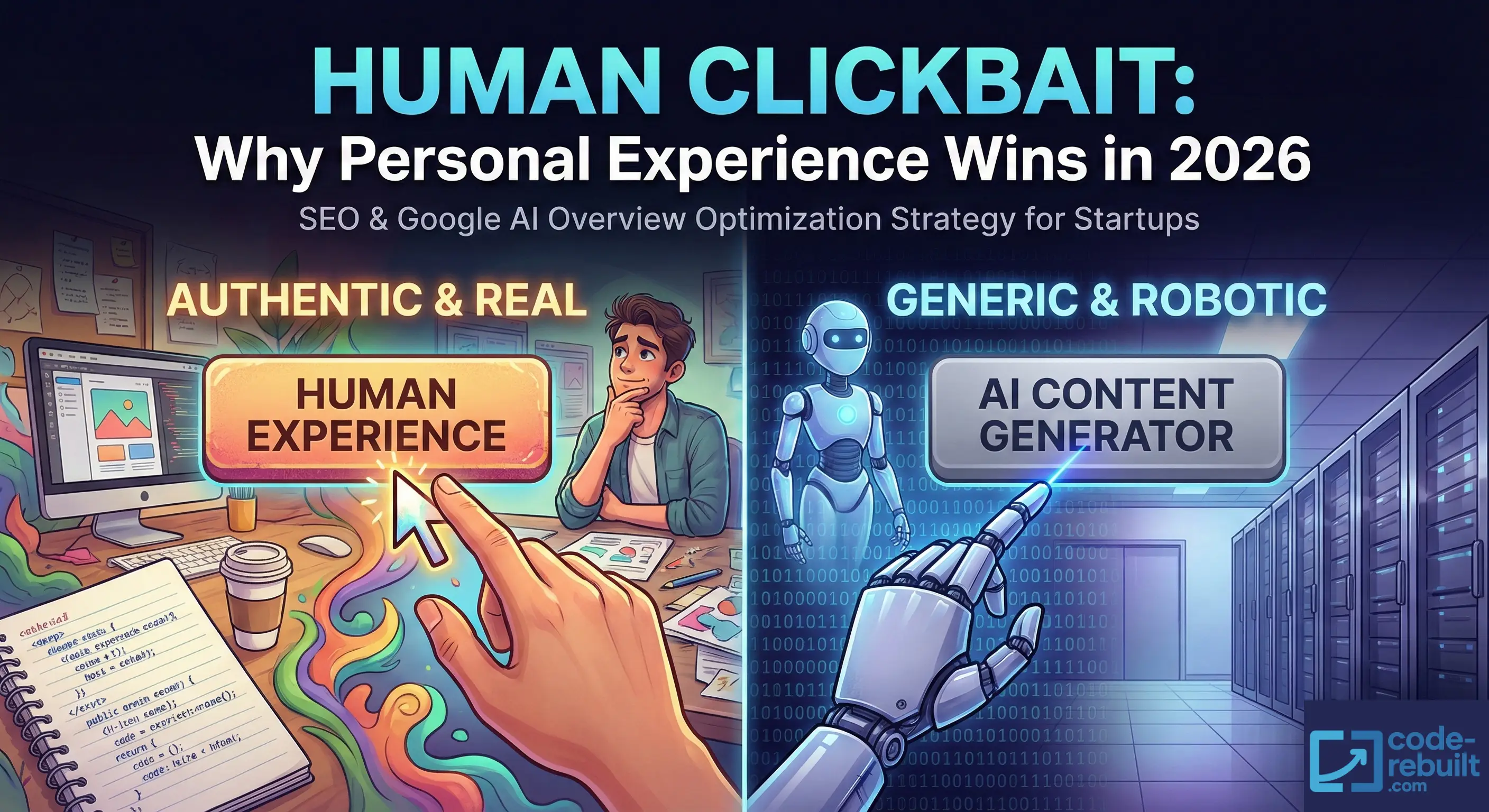
The difference between AI Content vs. Human Clickbait:
-
AI Content: "5 Best Practices for React Performance." (Generic, summarized data).
-
Human Clickbait: "How We Shaved 300ms Off Our Next.js Load Time (And The Mistake That Nearly Crashed Production)." (Specific, narrative, experienced-based).
The Google Shift: Why the Extra "E" Matters
A few years ago, Google updated its quality rater guidelines from E-A-T (Expertise, Authoritativeness, Trustworthiness) to E-E-A-T.
The extra "E" stands for Experience.
In 2026, this is the most critical ranking factor for informational queries. Google's algorithms (and the AI Overviews that sit on top of them) are actively down-ranking content that looks like it was synthesized by an LLM without real-world input.
Why? Because trust is at an all-time low. Users want proof that you know what you're talking about because you’ve done it, not just read about it.
The AI Overview Reality: To get your content cited in Google’s AI summaries, you cannot just repeat common knowledge. The AI is looking for unique data points, contrary opinions based on evidence, or specific case studies that add value beyond the general consensus.
How to Execute a "Human Clickbait" Strategy
If you are a startup founder, a lead developer, or a designer, you are sitting on a goldmine of "Experience" content. Here is how to mine it.
1. Document the Struggle, Not Just the Success
AI tends to output "best case scenarios." Humans connect with struggle.
Instead of writing a generic post on "How to hire developers," write about the time you hired the wrong person and what it cost your company. That vulnerability is authority. It proves you have the scar tissue to back up your advice.
2. Use "I" and "We" Statements
Academic, third-person writing is dead. Inject personality into your copy.
-
Bad: "It is often recommended to use Server-Side Rendering."
-
Good: "At Code Rebuilt, we switched to Server-Side Rendering for Client X and saw conversions jump 15%."
3. Show Your Work (Data & Visuals)
Nothing screams "human experience" like unique data or screenshots of your actual work environment.
If you are writing a design tutorial, don't use stock photos. Show screenshots of your Figma layers panel mess. If you are writing a DevOps post, show a redacted screenshot of your failed CI/CD pipeline logs.
These "proof artifacts" are signals to both humans and Google bots that the content is authentic.
4. Opinionated Takes Over Neutral Summaries
AI is designed to be neutral and safe. Humans have opinions.
Don't just list 10 tools. Tell us which three you hate and why the one you chose is better for your specific use case. Taking a stand on a technical topic (e.g., "Why we chose Tailwind over CSS-in-JS") invites engagement and establishes authority.
The Technical Foundation for Human Content
Great human content is useless if it’s served on a slow, inaccessible website.
While you focus on documenting your experience, you need a technical partner to ensure Google can actually read and rank it.
-
Performance (INP): If your site feels laggy, users leave before reading your brilliant insights. We optimize Next.js to ensure instant interactions, boosting your Core Web Vitals.
-
Structured Data (Schema): We implement technical schema markup under the hood. This helps AI agents understand that you are the author and that this content is a review or a case study, increasing the chances of being cited in AI Overviews.
Conclusion
In 2026, you cannot out-robot the robots. Trying to win at SEO by churning out massive amounts of mediocre content is a losing battle.
The winning strategy is to lean into what makes you human: your unique journey, your failures, and your specific expertise. That is the only thing an AI cannot generate.
You have the experience. We have the technical expertise to build the platform it deserves.
Ready to build a website that showcases your unique value? Start Your Project with Code Rebuilt today.